Transform Industrial Security with Claroty Integrations
Overview
Claroty provides deep visibility across Operational Technology (OT), IoT, and cyber-physical systems (CPS), helping organizations discover and secure critical assets. Integrating Claroty with your SOC and enterprise tools delivers real-time asset context, reduces blind spots, and enables faster, coordinated threat response without disrupting operations.
Key Products

Claroty xDome
A modular, cloud-native SaaS platform designed to support your entire industrial cybersecurity journey. It provides continuous visibility, asset discovery, and comprehensive risk monitoring across converged environments.
Claroty Continuous Threat Detection (CTD)
A robust, on-premise deployment option providing full-spectrum cybersecurity controls. It handles specialized threat detection and deep packet inspection for air-gapped or strictly controlled network segments.

Claroty Secure Access (SRA)
A purpose-built remote access management system optimized specifically for OT environments. It enforces strict, role-based controls and logs all third-party vendor sessions to prevent unauthorized modifications to critical machinery.
Claroty Integration Architecture
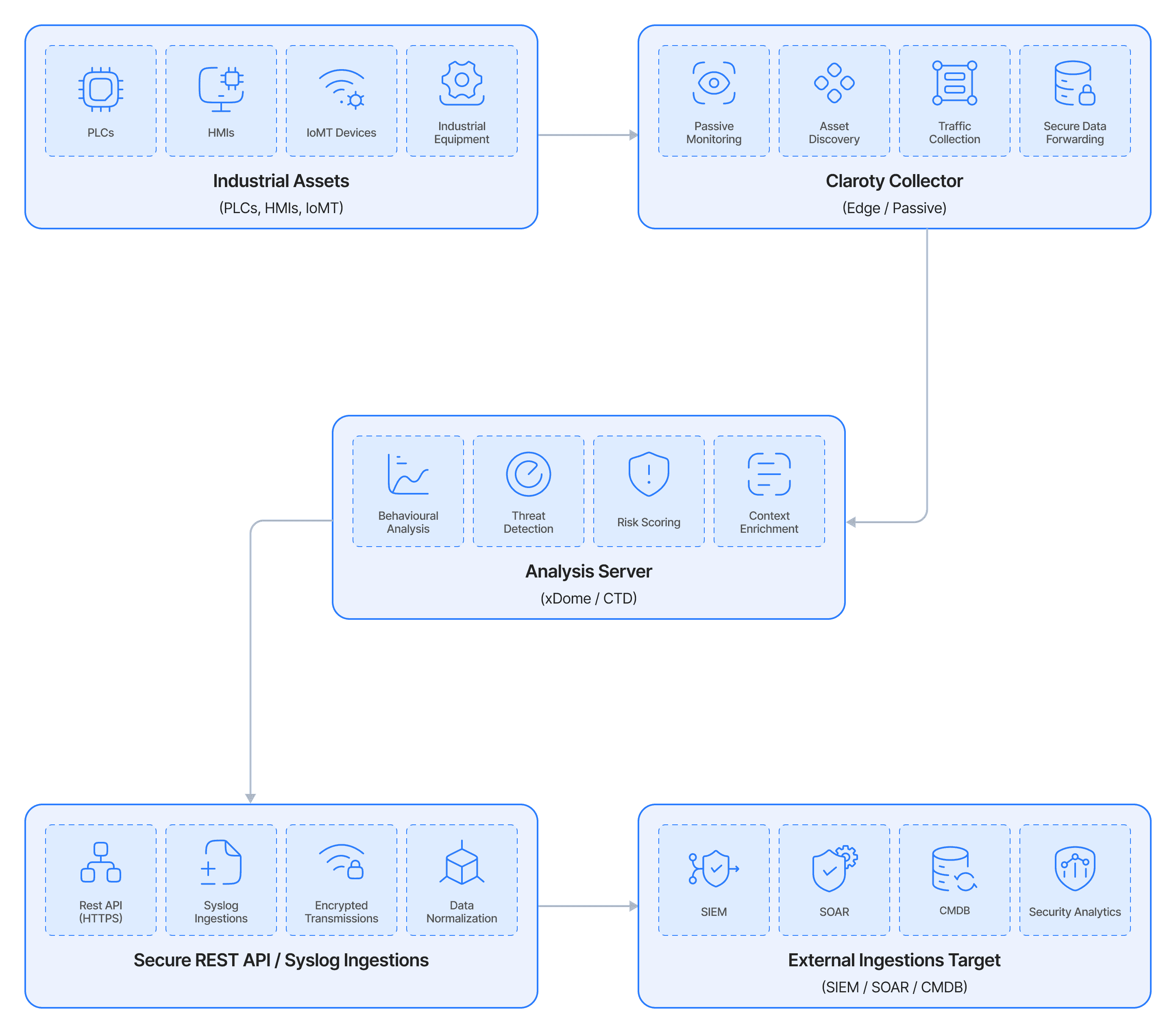
Data collection starts deep within the physical infrastructure via passive network traffic monitoring or lightweight collector agents. Claroty aggregates and parses these proprietary industrial protocols inside its cloud or on-premises analysis engines. Once identified, the platform normalizes the raw events, attaches asset risk values, and securely exposes this refined metadata to third-party endpoints through structured REST APIs or streaming message formats.
Streamlined Logic
1. Multi-Method Ingestion: Claroty captures operational network traffic using deep packet inspection (DPI) and edge configuration readers to securely index proprietary industrial hardware.
2. Parsing & Profile Matching: The internal processing engines match unique communication signatures against known profiles, identifying specific attributes like firmware, vendor, and clinical or industrial functions.
3. Exposure Scoring: Claroty cross-references asset profiles with public vulnerability data, CISA KEV catalogues, and threat signals to establish a localized risk weight.
4. Outbound API Dispatch: The integration architecture reformats the alerts, vulnerabilities, and asset details into standard structures (like OCSF or CEF) and delivers them securely to external ecosystems.
Claroty Integration Benefits
Webhook & Event Ingestion
Streams real-time alerts, system logs, and security policy anomalies directly out of Claroty instances using secure Syslog forwarding or structured HTTP hooks.
Bi-Directional REST API Sync
Pulls granular device profiles, including operational roles, vendor details, and firmware versions, and pushes configuration or containment commands directly into your firewalls and management tools.
Vulnerability & Exposure Ingestion
Periodically extracts normalized vulnerability logs and risk-scoring metrics to synchronize external Asset Management (CMDB) or Vulnerability Management tools.
Microsegmentation Enforcement
Syncs rich device identities and real-time communication patterns with modern zero-trust engines to automatically orchestrate network access policies.
Integration Use Cases
Automated Contextual Ticketing
Automatically enriches IT service desk tickets with industrial asset context. When an asset generates an alert, the integration adds device identity, location, and operational risk data to enterprise ticketing systems, helping engineers identify and resolve issues faster.
Risk-Driven Microsegmentation
Converts real-time asset visibility into automated network protection. Device classification and risk context are continuously shared with firewalls or NAC solutions, enabling dynamic policy enforcement and limiting lateral movement as risk levels change.
Unified Security Analytics
Consolidates OT alerts into centralized SOC workflows. Claroty events are normalized into formats such as OCSF and forwarded to your SIEM or data lake, providing unified visibility across both cyber-physical and enterprise environments.
Similar Connectors