Strengthen Cyber Resilience with Tenable Exposure Management
Overview
Tenable delivers comprehensive exposure management that helps organizations identify, assess, and prioritize cyber risks across cloud, IT, identity, and operational technology (OT) environments. Built for modern security and risk teams, it provides unified visibility into vulnerabilities, misconfigurations, and attack paths to support risk-based decision-making. Integrating with Tenable extends exposure insights across your security ecosystem, enabling faster remediation and more effective risk management.
Key Products
Tenable One
An AI-powered Exposure Management Platform that combines vulnerability management, web app scanning, cloud security, identity exposure, and external attack surface management into a unified security context.
Tenable Vulnerability Management
A cloud-native, asset-centric solution that accurately tracks dynamic computing environments, including containers, cloud resources, mobile devices, and traditional web applications.
Tenable Security Center
An on-premises vulnerability management solution that provides comprehensive, continuous visibility and deep vulnerability discovery across your local corporate infrastructure.
Tenable Integration Architecture
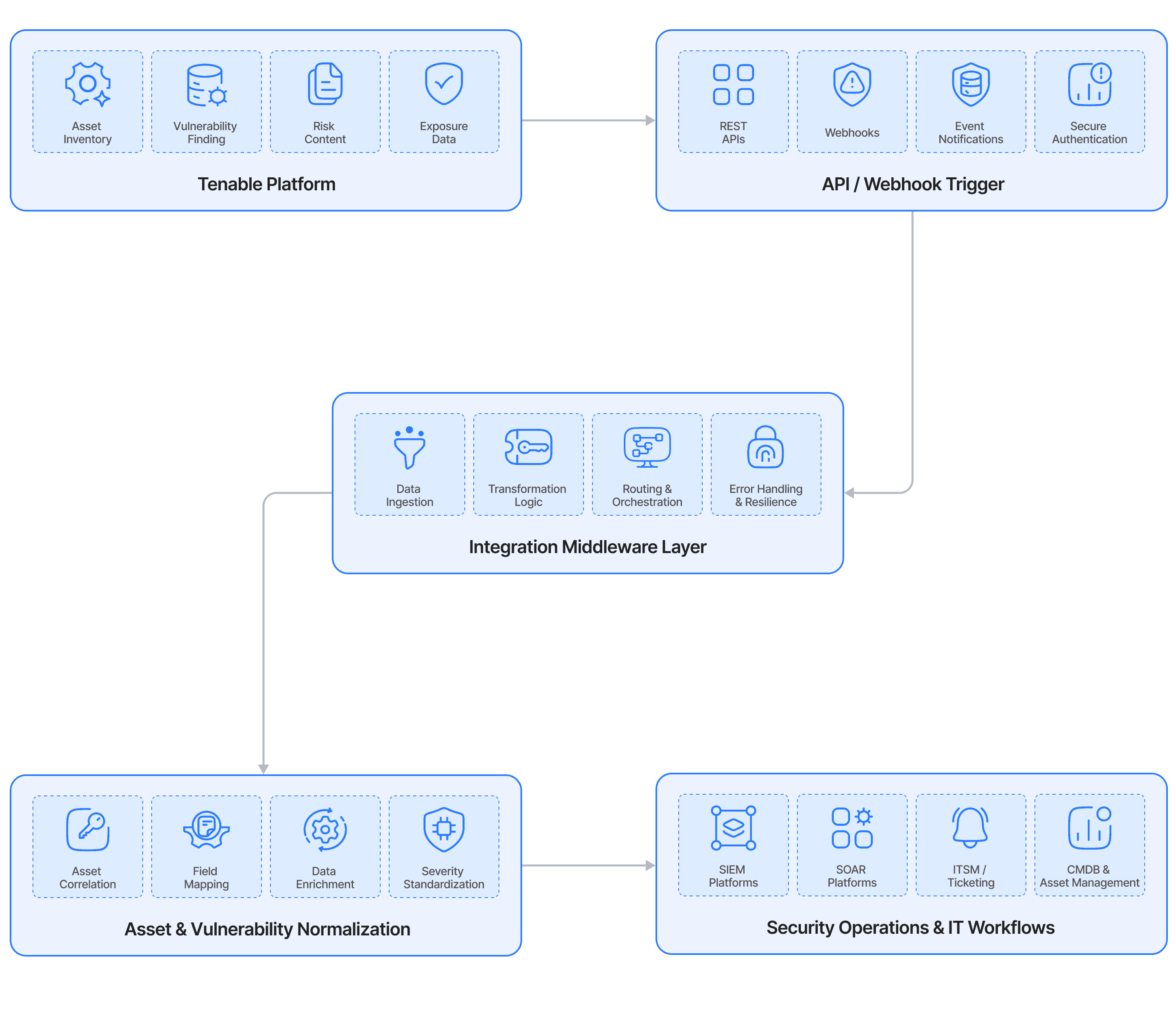
The integration pipeline routes stateful telemetry from Tenable's platforms via REST APIs or native cloud connectors. This data is dynamically passed to a custom middleware layer or a third-party endpoint, where assets undergo automated mapping, risk-prioritisation matching, and state-sync tracking.
Streamlined Logic
1. Initiate Data Export: The integrated application requests incremental vulnerability or asset findings via Tenable's paginated REST endpoints.
2. Normalize and Match Assets: The integration processes the asset metadata fields to compute unique identities using composite keys (such as hostUniqueness attributes, MAC addresses, or cloud IDs).
3. Context Enrichment: The pipeline evaluates the Asset Criticality Score (ACS) and severe vulnerability status against current threat indicators.
4. Push to External Workflows: Normalized alerts and findings route cleanly to downstream IT ticketing, CMDB repositories, or active threat response engines for immediate remediation.
Tenable Integration Benefits
Vulnerability & Exposure Ingest
Pull real-time asset telemetry, CVE records, and configuration vulnerabilities directly from Tenable into central SIEM, SOAR, or risk orchestration dashboards.
Asset Enrichment & CMDB Synchronization
Feed Tenable's discovered asset inventory, Asset Criticality Scores (ACS), and Asset Exposure Scores (AES) directly into configuration management databases such as ServiceNow to keep configuration items continuously accurate.
Automated Scan Triggering & Orchestration
Execute contextual vulnerability and web application scans programmatically using webhooks or playbooks during critical events or continuous deployment pipelines.
Remediation & Ticket Tracking
Link discovered vulnerabilities straight to developer ticketing or configuration tracking tools, tracking continuous verification statuses from initial detection to automated verification closure.
Integration Use Cases
Continuous Bidirectional Data Sync
We create robust pipelines that systematically synchronize assets between your internal repositories and Tenable. This ensures that security alerts always align with the exact live data inside your operational environments.
Risk-Priority Remediation Routing
This mechanism filters high-severity data dynamically. It shifts emphasis from raw numbers to actionable remediation by filtering vulnerabilities through active threat metrics and critical asset values.
Automated Incident Loop Closure
We streamline workflows by linking ticket tracking statuses back to active scan endpoints, which closes the loop between initial discovery and active validation without manual overhead.
Similar Connectors